
So you’ve decided to start working for yourself—good choice. Whether as a small part-time side hustle or as your main bread and butter full-time job, being your own boss or business owner is a great way to make some extra money. Read on to see how to file your taxes.

This post may contain affiliate links, which means I may receive a commission, at no extra cost to you, if you make a purchase through a link. As an Amazon Associate, I earn from qualifying purchases. Please see my full disclosure for further information.
The situation is similar whether you choose Uber and/or Uber Eats. You are being paid as a contractor instead of as an employee.
Of course, there are some advantages and some disadvantages. We will explore these in detail and how they affect you regarding taxation.
Again, there must be advantages; otherwise, why do it?
Let’s start with the positive. Being your own boss allows you to control your time more. So, you don’t necessarily have to work if you don’t have time.
In terms of taxes, it seems more tedious because you are likely to get a tax bill, but at the same time, you can write off several expenses that you would not be able to as an employee.
Setting yourself up appropriately from the get-go will make your life much easier, even at tax time.
Before we examine that, let’s discuss the disadvantages.
As a self-employed individual who has been self-employed for well over a decade, the biggest obstacle is the lack of job security.
That being said, there is no such thing as job security these days.
In this case, you are at the mercy of Uber and/or Uber Eats. But you may not be limited to them. As a contractor, you can do the same job for other businesses, too.

Next, they (I am referring to Uber and/or Uber Eats) do not take off source deductions from your pay. So if you are being paid $15/hour, you get $15/hour.
It is up to you to pay those deductions to the government on your taxes instead. However, one way to look at this is that you get the money now, and pay it to the government at a later date.
This is where it is essential to set yourself up properly right from the start. The best advice for this is to set aside a portion of the money you make, say 25%.
So, for every dollar you bring in, put at least $0.25 aside in a High-Interest Savings account for the inevitable tax bill.
How do you pay those deductions but put more in your pocket?
Now comes the fun part. As a professional tax advisor, I must point out that this whole tax strategy is part of the financial game, a legal game, as long as you are honest from start to finish.
We start the tax game by indicating the total amount you made from Uber and/or Uber Eats. Typically, they will provide you with a statement showing the income information including the amount they paid you.
After having experienced tax filing for several clients who worked through Uber drivers and Uber Eats, verify the amount with your bank statements because sometimes there is a difference.
If there is a difference, it is almost always due to fees. You can either indicate the total amount with fees as the gross total or the total without the fees but then add those fees as an expense in the tax software.
Either way works, and frankly, it makes no difference. As the saying goes, six of one or half a dozen from the other.
When declared on your income tax return, the total income is your gross income.
So what about potential business expenses?
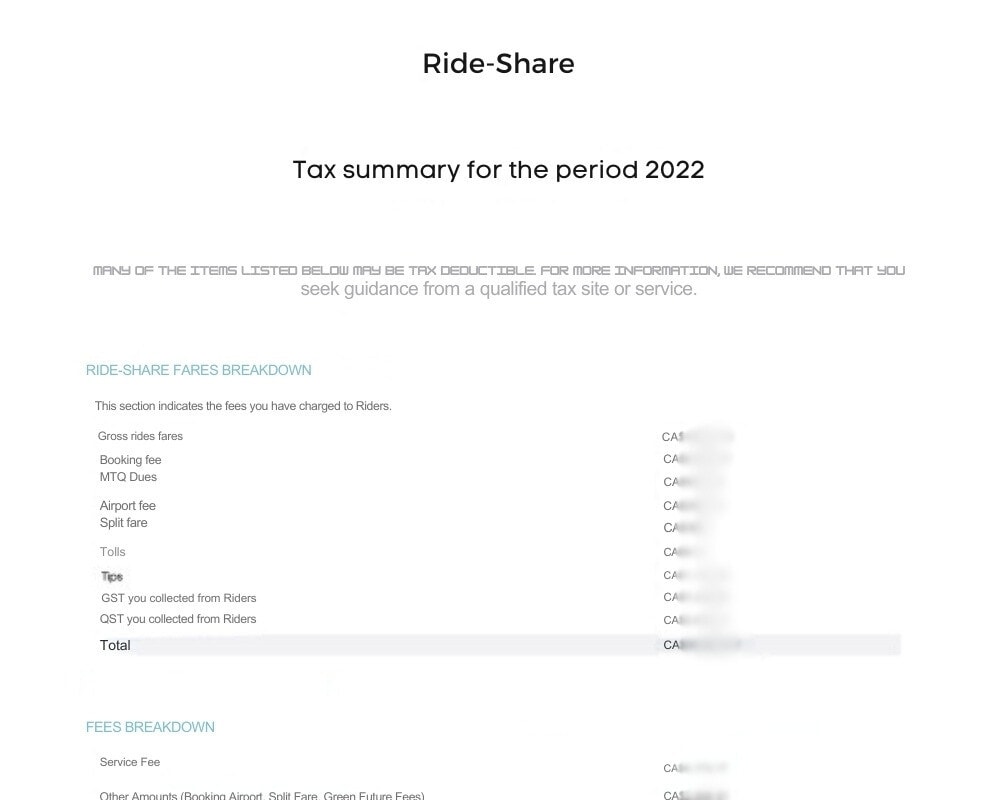
Next, we look at what you paid out of pocket to make that money. Did you use your phone, your car, your internet, your bank account, etc?
If you did use items you paid for, you can deduct a portion of that expense proportionately.
Again, be honest. Let’s take, for example, your cell phone. You almost certainly used it for Uber or Uber Eats, right?
If you did, you need to figure out what portion you actually used for work. Let’s assume you used it for 6 hours a day for seven days per week. That would translate to 42 hours a week, so 25%.
Now, we translate that to your taxes. If you spent $50/month, tax included, on your phone bill and worked for one full year with the hours indicated above, then you can write off $12.50/month for your phone bill.
It probably doesn’t seem like much, but remember that you do that same calculation for every item you use to generate work and pay for out-of-pocket.
The following important detail helps make it add up: that deduction lowers your gross income dollar for dollar.
So if you made $25/month and wrote off the $12.50 for your phone, then you get taxed on $12.50 (the balance)
Obviously, these are not realistic numbers but are being used solely to show simplistic calculations.
All these expenses get combined and deducted from your gross income to determine your net amount for your business taxes.
How the government sees you.

As Canadians, there are four ways to be viewed by the government;
– Employee: Few deductions, taxes partially calculated by your employer,
– Sole Proprietor: Self-employed person, independent contractor where you specify your tax calculations,
– Partnership: Same as self-employed, but with two or more individuals. Each specifies their own tax calculations,
– Incorporation: Own entity with shareholders, who calculate its own tax calculations.
As an Uber ride-share or other ride-share driver and/or Uber Eats, you are considered to have earned self-employment income as a sole proprietor.
You must be careful, as you do not have an employer who removes your source deductions, so you will be on the hook at tax time, as specified above.
Another aspect that seems foreign to many new self-employed workers, whether part-time or full-time, is that some of these activities will require you to file and pay GST(Goods and Service Tax), HST(Harmonized Sales Tax), and PST(Provincial Sales Tax) reports.
This type of filing is entirely separate from your standard annual income tax filing and has its own obligations and registration.
Filing GST, HST, and PST can be simple if you use tools like Excel or Numbers to calculate your input tax credits (ITC) to counter the amount of GST, HST, and PST owed.
This report states that you collect taxes as part of your business, which is not yours.
You have to pay that amount to the respective governments, but you get to decrease the amount owed by the taxes you pay to make that money.
This is the ITC above. If you operate a ride-sharing service, you probably bought gas? If so, the taxes you paid for that gas can be proportionately deducted from the taxes you collected.
Many clients have found this to be complicated; for some, it can be.
If you find this complicated, you always have the right to use a bookkeeper or accountant. Their service will cost you a fee, but it could be well worth it.
If you are looking for an accountant, we recommend the firm Gauvreau & Family, which you can reach out to.
Like with all advice, here are some recommendations.
Before you start, or if you’ve started recently, do some homework based on your province of residence. This is partly because of how your province views HST or PST and how to register for GST and HST numbers.
If this seems overwhelming, don’t stress there is help.
If you have a tax specialist that you currently work with, speak with them. If not, we have a firm that is ready and happy to help you. You can contact them at gauvreauetfamille.ca.

Next, please keep track of everything, especially your kilometres, whether you use a car, motorcycle, or other vehicle.
By the way, according to the CRA website (Canada Revenue Agency), you are required to have, maintain, and keep a kilometre log to write off your vehicle’s expenses.
This kilometre log will help determine the proportional amount of all your vehicle expenses that can be written off.
We recommend Mile IQ for the kilometre log as it is simple to use and runs in the background of your cell phone.
Some examples of vehicle expenses that can be included are registration, license fees, maintenance, gas, insurance, parking fines, and either interest on the purchase or lease costs.
How do you complete your taxes?
If you are still reading, you are either looking for a recommendation on how to file the taxes, or you are confident that you are ready to tackle it head-on.
If you still feel that the task of completing your taxes is too overwhelming, there is nothing wrong with that. As the French saying goes, “Chaqu’un à son métier,” which translates to “Each to their own line of work.”
So, if you find it overwhelming, you can skip to the end of this article to see who we recommend with a link to their contact page. Otherwise, read on.
If you are confident in your ability to tackle it yourself, great. Use tax software like UFile. We recommend UFile because it is user-friendly and cost-effective.
Self-employment taxes are included in your personal tax return. If you ever get to the stage of incorporation, then it is filed separately with its own filing requirements.
We look at the different business structures in our article Business Taxes.
Adding a self-employment portion within the software is quick and simple. There are several options, including business, professional, commissioned, or farming.
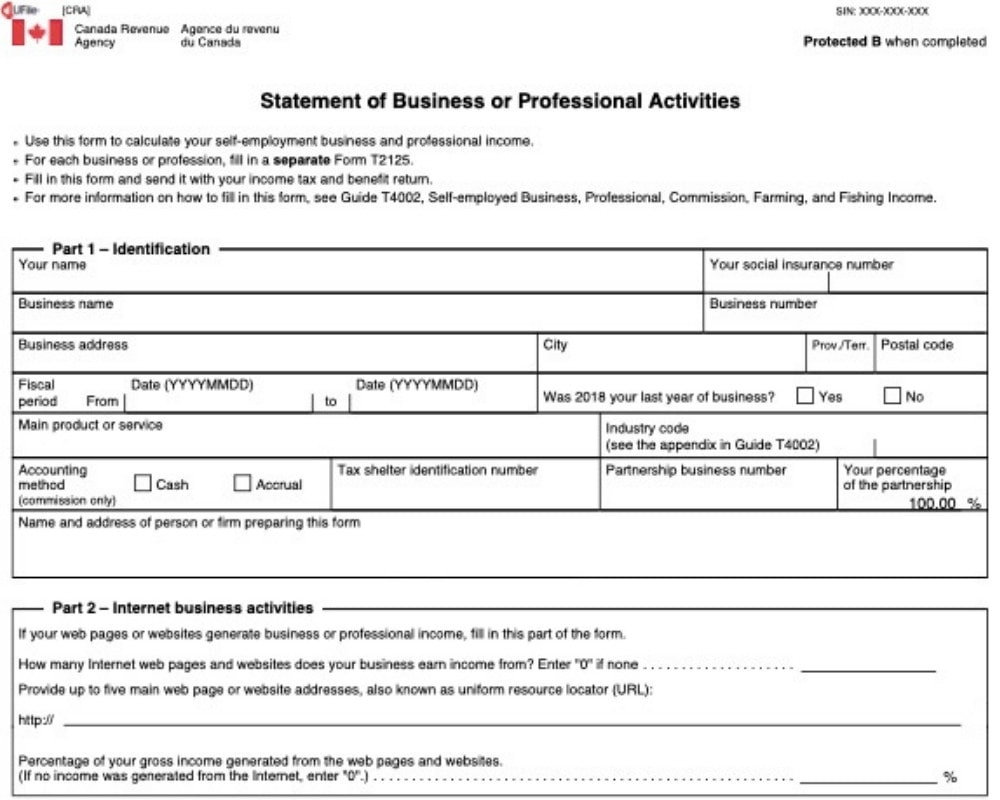
Depending on how you get paid by your line of work determines which form T2125 to use.
If you were paid a commission by Uber, Uber Eats, or other ride-sharing companies, then use the T2125C commission and fill out all the relevant boxes.
There are likely only a few boxes that need to be filled out, depending, of course, on how you operated and to what extent. Having detailed records really helps to complete the filing as well if you need to prove them.
One essential aspect to be aware of is purchasing equipment.
If you purchase equipment for business use, depending on its value, you can claim it as an expense for that tax year or as an allowance. Every item is slightly different in terms of value and classification.
A general rule of thumb is that if the cost or value of the item is more than $500, it falls under the heading of CCA (Capital Cost Allowance).
Within this heading, items can have a portion of the cost deducted each year you use it to generate an income. Each class has its own deductible percentage.
Of course, the item you purchased has to be relevant to the self-employment work you are doing to earn an income. So, if you are an Uber driver or Uber Eats delivery, you can’t write off a snow blower or entertainment system. Be logical.
Once all your income has been indicated and all your relevant expenses have been included proportionately, you have your net income. Next, do this for each type of your different business activities.
For example, if you are an Uber Eats delivery driver and blogger, you have one full self-employed statement of business for Uber Eats and another for your blog’s professional activities.
BE HONEST.
This is, in my opinion, the number one rule. If you try to cheat the system, it will come back with a vengeance! The government is not stupid, so work the system appropriately.
If you use your cell phone for work and personal use, don’t try to write off 75% or more; it’s unrealistic.
However, if you had to buy an Android phone because the software or food delivery app does not work on Apple, and you have your iPhone for personal use, that can be appropriate.
You should always assume you will be audited, so be honest. If you can’t prove what you state on your taxes, don’t claim it. If you are honest, you probably have nothing to worry about.
If you have two cars, for example, one for personal use and the other strictly for work, that can be proven, right?
Keep in mind that the government can verify your details without you knowing if they choose to.
What’s next?
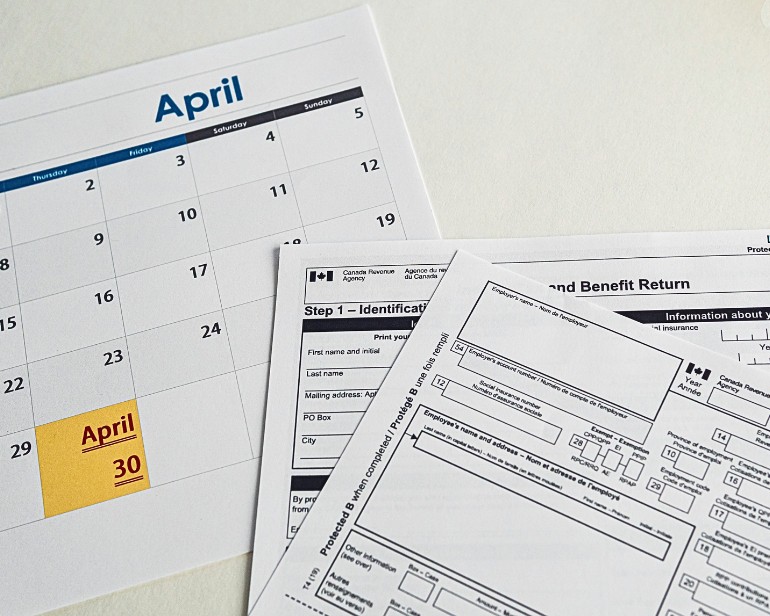
If you decide to tackle your taxes yourself, file them on time. If you owe money, make sure you pay it before April 30th.
As a self-employed worker, you have until June 15th to file, but the deadline is still April 30th if you owe money.
If you pay your tax obligations later than that, they will incur penalties and interest on top of the amount owed.
If you used an accountant, make sure your return gets filed.
Either way, make sure that you keep all your records and proof, as it is always up to you to provide records if the government requests them.
We strongly recommend that you keep digital copies of everything. To start with, you should have and use a good-quality scanner like the Fujitsu ScanSnap to digitize both papers and receipts.
Next, keep your digital records on more than one device. If you keep them on your computer, that is okay as long as you use another device, like a thumb drive or cloud server, as a backup.
For thumb drives, we strongly recommend the Sandisk Cruiser Glide or Sandisk Extreme SSD, which can allow you to encrypt your files.
For a cloud server, we strongly recommend Proton Drive for storage. The main reason for this is that Proton is a Swiss company following Swiss laws, so it is not subject to the U.S. Patriot Act. Your information is encrypted.

Finally, if you do not know how to file your taxes or would like some guidance, you can contact us through our Contact Us form or the tax specialist at Gauvreau et Famille, who are happy to help.
You can read our article on Personal Canadian Income Taxes to learn what the basics are.
Just remember, you don’t need to go it alone.