
So you’ve decided to take the plunge; congratulations are in order. Working for oneself is a great way to make money, but it can also be quite tricky and stressful. Read on to see how you can put more money in your pocket.

This post may contain affiliate links, which means I may receive a commission, at no extra cost to you, if you make a purchase through a link. As an Amazon Associate, I earn from qualifying purchases. Please see my full disclosure for further information.
Unlike a job, you do not get the security of a paycheque every week or two weeks. Rarely is the amount on your paycheque the same every time, either.
So, how do we manage regular inquiring bills? There is only one answer: Planning!
Taxes for self-employed individuals use the same answer: it takes Planning.
For most of this article, we will specify the federal details and regulations because they are the same for every province and territory. Still, there are some unique specifications for some provinces.
Step one, if you are not sure, please speak with a tax specialist and obtain some professional help to avoid getting yourself in trouble.
If you have tax expert you trust, talk with them. If not, we have a firm that is ready and happy to help you out. You can contact them at gauvreauetfamille.ca.
So what is being self-employed?
Almost any type of work can be or become a self-employed business.
Some that have come up a lot lately are things like Uber, Uber Eats, Blogging, Influencers, Vlogging, Product researchers, rental properties, room rentals, some professional activities, and so many more.
One suggestion I regularly make to financial clients looking to make some extra money is to figure out what they like doing in their pastime and see if there is a market for that, a side hustle if you will.
In the past, we’ve suggested that some elderly clients were advised to sell what they knitted or offer a clothing repair service to friends and family if that is what they enjoyed doing as side gigs.

Now, we start with the basics. LLC or sole proprietor?
This is a question I get constantly and have seen asked in groups everywhere. The answer is simple: LLC (Limited Liability Company) is a form of designation that does not exist in Canada but is in the U.S.A.
In Canada, there are three levels of business designation for business income taxes. Each has its unique specifications as well as reporting criteria.
The three levels are sole proprietorship, Partnership, and Incorporation. Let’s take a closer look at each because each has some pros and cons.
What is a Sole Proprietor?
A sole proprietor is just a regular business where you are both your own business and, most likely, the employee.
Some good examples of this level are Uber drivers, Taxi drivers, Bloggers, Vloggers, Influencers, private dépaneurs (convenience stores outside Québec) and some Financial Advisors.
This level of business is the simplest because you are the one and only; you take on all the risks but also get all the advantages.
Generally, if you don’t work, you don’t get paid. This does not mean you can not have employees; quite the contrary.
A sole proprietor you are your own boss, but you can have employees if they should choose. Simply put, you are the business.
In terms of income taxes, this business level follows the same basics as your regular income taxes. The filing deadline is the same as well.
However, unlike an employee filing income taxes, there are many business expenses that you can deduct. We will look at this more after explaining the different levels.
Now, we will look at Partnership.

This is pretty self-explanatory: a partnership is a form of business where two or more individuals decide to embark on a business venture together.
How does this differ from a sole proprietor? Simple, everything is split into two or more pieces. As a sole proprietor, you take on all the risks and get all the rewards.
As a partnership (for this example, we will assume a partnership of 2 individuals), you take on half the risk and get half the reward. A partnership is very much like a marriage.
Every business level has pros and cons; this one is no exception.
A partnership’s main advantage is that two or more heads can serve the same purpose. It also has an automatic integration of an accountability partner, something many of us can use.
Having two or more people promote the business is much easier than one person spreading the word themselves. If done very well, this can amount to compound growth.
Plus, not everyone is good at every aspect of the business, so dividing and conquering is a handy tool within a partnership.
If the business venture needs Capital (funds necessary to start up or expand, for example, a loan), it may be easier to qualify for or even qualify for more funds if more people are on the hook for the loan.
This can also be beneficial if one or more of those people have better or more excellent credit ratings.
Those are some of the advantages, but now here are some cons or disadvantages.
Like a marriage, you must trust the other partner(s). It sounds simple and obvious, but this is the most significant cause of a partnership ending.
When meeting clients who are interested in starting a business as partners, regardless of how many partners, my list of recommendations ALWAYS starts the same way.

Create a written Partnership Agreement, irrespective of how well or how long you have known each other. Again, it sounds simple, but it needs to be written down.
This is a significant obstacle because if it is not written down, how can you refer back to it? It becomes a lot of he said – she said. My clients tend to ask me to explain the agreement, and this is what I always say:
“The partnership agreement has to contain, at the very minimum”,
- Who is involved in this Partnership,
- What is everyone’s capacity within the Partnership,
- What are everyone’s duties within the Partnership,
- What is the percentage of Partnership (not all partnerships are 50/50),
- How are disputes going to be resolved if they come up,
- What happens if a partner does not perform their duties,
- What happens if a partner dies or becomes disabled?
This is an example of a fundamental starting point of the agreement. Every agreement is different, but it should have those details at least.
As stated above, the most significant cause of a partnership failing is lack of trust, but the second is where one or more partners do not do as they said they would or agreed to.
Having written down the agreement makes it a whole lot easier to see who agreed to what and what happens when.
Next, we will look at a Corporation.
This is an entirely different animal when it comes to a business level.
The best way to explain what a corporation is is by explaining that it is its’ own entity. You, as the creator, have created a whole new being, like having a child.

Let’s take that analogy a little further. Like with a child, you are fully responsible for the child until they have reached the age of majority.
A corporation is very similar; you start the Corporation, then you are responsible for it and on the hook until you have grown it to the point where it is independent of you.
What are the benefits of starting a corporation?
Well, the simple answer is eventually, the Corporation will be responsible for the Corporation. The Corporation or entity takes on its own risks and obtains its own rewards.
As the president or leader of the Corporation, you can also get some rewards, but in a different way, such as dividends. If a corporation makes a profit, you can earn dividends (simply put, a portion) from that profit.
I mentioned the president or leader, but all corporations in Canada are composed of shareholder(s).
You can have a corporation with one person holding 100% of the shares or multiple individuals holding a portion amounting to 100% of the shares.
What is a Share of a corporation?
The best and simplest way of explaining what shares are is a pie. You can have one person have the whole pie or cut it into slices or parts. Each part or slice represents a share of the pie or a share of a corporation.
What is the purpose of a share of a corporation?
A share of a corporation is essentially a part of the company. It allows you to own a piece of that pie or Corporation.
As a general rule, when a corporation needs to make a decision that affects the Corporation, for example, merging the company with another or dissolving, that share allows the owner to vote.
Generally speaking, one share is equal to one vote.
However, many corporations have a leader or president who typically has a controlling interest in the Corporation. A controlling interest is someone who owns more than 1/2 of the shares.
However, you can also have corporations where the leader does not have a controlling interest, but rather has a significant interest to help make decisions.
How does the Corporation get taxed?
In terms of taxation, it is very different. A corporation is responsible for filing its own corporate taxes every year.
It is responsible for having and providing a book of paperwork to show what assets are in the Corporation’s name, how much it made each fiscal period, how much and what expenses it had each budgetary period, how much receivable in it entailed, and so on.
What is a fiscal period?
A fiscal period is the period of time (1 year) that the Corporation uses to keep its records. For us Canadians, our fiscal period on the personal level is the calendar year.
We provide our income tax declarations on a yearly basis from January 01st to December 31st of each year. This is OUR fiscal period.
For corporations, they can use whatever period they wish to use.
Many simply use the date the Corporation became established as their starting date. If a corporation became established on October 05th, it could use a fiscal period of October 05th to October 04th of the following year.
For many of my clients, I recommend to keep it simple. Use the calendar year as the fiscal period, even if they did not establish their Corporation on January 01st.
It does most often mean some extra paperwork and extra costs because if they start their Corporation in October, for example, they would have ALL the required paperwork to file but for a period of 3 months (i.e. October xth to December 31st) instead of an entire year.
However, the flip side of this is going forward, their record-keeping will be far, far easier to manage. If they had a bill that they needed to find, it would be easier to find it based on the year rather than the year plus month plus day, depending on their fiscal period.
Some other key points relevant to the Corporation’s taxation portion are the deadline and how they are taxed.
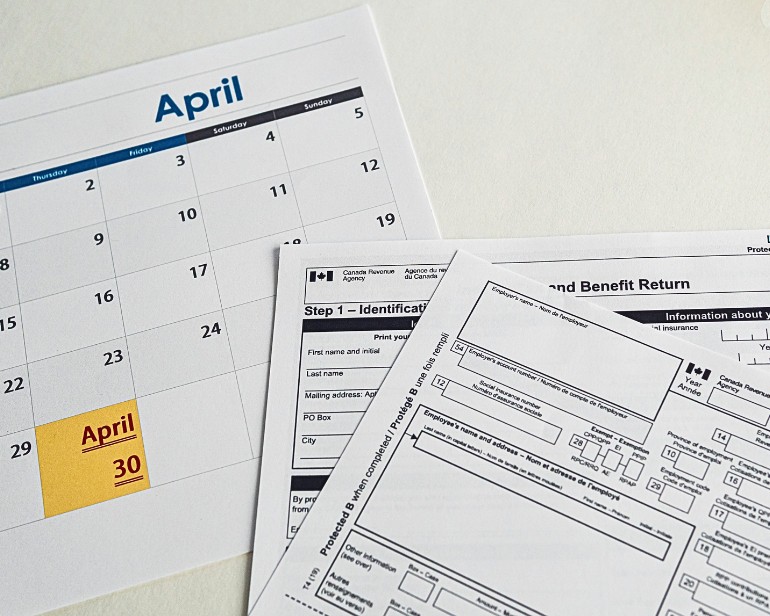
For the deadline, unlike a personal or self-employed tax return, it is due six months after the fiscal period. So if your fiscal period is April 01st to March 31st, you must file the paperwork and make the payment by October 01st of that same year.
How corporations are taxed is also different from personal income taxes.
Like the personal income tax rate, there is a federal tax rate and a provincial tax rates. Going forward, we will discuss the federal level.
The calculations for corporation income taxes are quite complex and depend on the Corporation’s size and how it is controlled.
The starting point for Canadian federal tax rates is 38% for the basic rate for corporations for up to $500,000. There is an abatement of 10%, which is credited back, giving a basic rate of 28% if the Corporation is entitled to it.
There are other amounts to be aware of, such as the GTR (General Tax Reduction), which can reduce the taxable rate by 13% and the SBD (Small Business Deduction), which can reduce the tax rate to 9%.
Again, these reductions are only for corporations who are entitled to them. These rates are stated on CRA’s site as of February 07th, 2024, and are subject to change.
As a tax specialist and tax preparer, I strongly recommend using the help and guidance of an accountant, CPA, or tax preparer to prepare your corporation tax returns, as they are quite complex.
Now, we can look at expenses. We will mainly look at sole-proprietorship and Partnership because corporations have similar expenses but in far greater detail.

This is where it starts getting interesting to be self-employed because, in some ways, a person who is an employee making $50,000 a year gross can be on a par with a self-employed person making $25,000 a year.
This is because, as self-employed individuals, we can deduct many expenses from our income that most employees are not allowed to.
Below is a short comparative table with SOME of the eligible expenses that a self-employed individual can deduct.
| Type of expense | Employee | Self-Employed ** |
| Cell phone | Potentially | Yes |
| Supplies | No | Yes |
| Internet | Potentially | Yes |
| Home office | Potentially | Yes |
| Office furniture | No | Yes |
| Car | Potentially | Yes |
| Home insurance | No | Yes |
| Bank fees | No | Yes |
| Electricity | Potentially | Yes |
| Heating | Potentially | Yes |
| Trainings | No | Yes |
| Meals | No | Yes |
| Legal fees | No | Yes |
| Accountant fees | No | Yes |
Obviously, this is not a complete list, but a starting point to take into consideration.
We indicated ** for the self-employed because, yes, those expenses are generally eligible, but not for every self-employed business. Each type of work has its appropriate expenses.
The way CRA (Canada Revenue Agency) states this on their website www.canada.ca is this:
“You cannot claim expenses you incur to buy capital property. However, as a rule, you can deduct any reasonable current expense you incur to earn income. The deductible expenses include any GST/HST you incur on these expenses minus the amount of any input tax credit claimed.”
What is a reasonable expense? That depends on your line of work. For example, if you operate only out of a rented commercial property, you can’t deduct a home office or related items.
The same can be said with supplies; if you blog about Canadian taxation, do you really have supplies to deduct?
Why is there potential for employees?
Some may wonder why I specified “potentially” under the employee heading for some items; well, that is because they may be eligible for deductions.
This aspect became far more prevalent during COVID-19 but existed for years prior.
If an employee is contracted to work from their home or be on the road using their own equipment (car, phone, internet, etc.), then with proper indication and paperwork from their employer, they can deduct a portion of those expenses from their taxes.
There are many guidelines and specifications that have to be respected for this to be eligible. Not to mention that the government may change which expenses are eligible for a tax year.
The main specification is that you had to have paid for it out of pocket and not be reimbursed by your employer.
For example, if your employer requires you to use a phone and either pays for your cell phone or reimburses you for what you paid and does not supply one, you can’t claim that expense.
But if they did not reimburse you but still required you to use your personal phone for work, then you can claim it partially.
Why partially? Because the government knows that you also use it for personal use as well. So be honest.
What can we deduct for a home office?
At this point, it gets to be a little more complicated, regardless of whether you are self-employed or an employee.
There are some expenses that employees are not allowed to deduct that self-employed or commissioned employees can, such as home insurance, office supplies, and small repairs.
Like all other expenses, they must be reasonable and required to generate an income.
For a home office, the requirement is for it to be a dedicated workspace based on the percentage of the total square footage of the home.
For example, if you have an apartment that is 1000 square feet, and the office takes up 100 square feet, then you can potentially deduct 10% of all relevant expenses.
So, what are relevant home office expenses?
The main home office expenses that come up are the rent, electricity, heating, landline phones, internet connection, property taxes, small repairs, home insurance, etc…
Not all are recommended, and not all qualify, and some only partially count. So again, speak to a trusted tax specialist about your situation.
As a general rule for homeowners operating a business out of their home, I recommend not deducting some expenses that could adversely affect the principal residence exemption.

What is the Principal Residence Exemption?
This exemption has to do with the disposition of your personal primary residence. If you sell your primary home (as opposed to your secondary home, i.e., chalet), then you can claim the exemption on the amount of the gains obtained.
This means that if you bought your home for $250,000 and sold it a few years later for $400,000, you would not have to pay taxes on the $150,000 increased Capital Gains amount.
How does that relate to business taxes?
If you use your principal residence for work, for example, room sharing or rent out a portion as an office, then that portion of the residence loses its tax exemption.
So, writing off a portion of your mortgage or property taxes could cause issues when you sell your home. Again, for more specific situations, please speak with a tax specialist.
Can we deduct car expenses?

This question comes up a surprisingly large amount of times. Of course, we can deduct car expenses when reasonable and required to make money.
Like the basic expenses and home office expenses, vehicle expenses can also be included as eligible expenses if specific criteria are met.
For example, if, as an employee, you use your car to go to and from the office, then you are not permitted to deduct that expense.
What surprises a lot of self-employed is that the same is true if you are self-employed and work out of an office away from home. The related expenses for that portion are not deductible.
To explain better, if you operate a store that is 5 km away from your home, the 10 km trip you drive (to and from work) is not allowed. This is valid for both self-employed and employees using their car for work.
However, as a self-employed individual, if you stop off to pick up supplies or see a client between work and home, then the whole one-sided trip is deductible.
A note to be very aware of is that not all situations or businesses can deduct vehicle expenses, so checking your situation with a tax specialist is critical.
What are the allowable expenses?
There are actually quite a few eligible car expenses, some most people would not expect to be allowed.
The most common ones are gas or electricity for electric vehicles, insurance, maintenance, short-term rental, vehicle registration, your driver’s license, and parking tickets.
Depending how the vehicle is owned changes how another deduction is calculated.
If you purchased your vehicle, then during the period that you are paying it off, you can include the interest only. If you lease your vehicle, you can include the lease payment.
Additionally, a part of the vehicle can also be partially taken into calculation. This is called a Capital Cost Allowance.
There are many different calculations for different assets that are purchased and depreciate over time. This is not limited to vehicles.

Let’s now talk about what restrictions there are for adding a vehicle.
Like with all other expenses, this needs to be reasonable and required to generate an income. There is more; however, the main one is that to be eligible by the CRA, you are absolutely required to keep a mileage log.
One of the reasons for this is that the government wants to ensure that you are only considering real amounts and not guesstimates.
There are a few options here, depending on how self-reliant or meticulous you are. The most common and classic way is with a notebook and pen.
You would need to log the KMs at the start and stop of every voyage and then specify if it was work or personal.
As a professional who uses a vehicle for work, I strongly recommend an app that I personally use and am content with.
The app I use for keeping track is MileIQ, an independent company since 2021. It is a GPS app operating in the background on almost every smartphone.
With this app, you need to go into the app and classify each drive.
As an accountant, it is also helpful because, at the end of the year, you can download a report to clearly show the total KMs for the year and the total KMs for business.
With this information, we accountants can quickly determine the calculations required for the eligible expenses of the vehicle.
The next crucial point for self-employed individuals to look at is Planning.

How does Planning relate to being self-employed? Well, lack of Planning has been a significant downfall for many businesses.
To help explain this section, we will start by looking at a typical employee situation. When you work for someone, they pay you a gross amount. But that is not the amount you actually get, is it?
No, from that gross amount, the business is required to deduct source deductions, which include federal income tax, provincial income tax, health funds, Canada pension plan contributions(or provincial if in Québec), group benefits, and a few others.
This part is provincially based, so it depends on which province you work. Some have more deductions, and some have less, so your net income is less.
That said, if your gross pay is $25/hour, you are not walking away with a $25/hour paycheque.
Contrary to an employee, as self-employed workers or small business owners, if you charge a client $25/hour, you get $25/hour.
However, you are on the hook at tax time for all the regular deductions that are already calculated and deducted from the amount that an employee had.
So, how does that relate to Planning? If you are collecting $25/hour, you will need to pay the deductions eventually, so make sure to set a portion aside for that certain bill to come.
Since every business differs, we can only suggest a general rule of thumb.
If you are making between $0.00 and $40,000 per year, I generally recommend that you set aside about $0.25-$0.30 for every dollar you take in.
If you are making between $40,000 and $50,000 per year, I generally recommend that you set aside about $0.35-$0.40 for every dollar you take in.
This is because you will almost certainly get a bill, but you will also most likely have expenses to counter the income.
In order to plan however, you need to keep track of everything, keeping track of your income, keeping track of your professional fees as well as all other business-related expenses.
With this information you can prepare for tax savings and figuring out your tax obligations.
What if my expenses are more than the money coming in?
This is a very common question I see very frequently. Claiming a loss is actually more common for businesses that start, and yes, the government understands this and accepts this.
However, it must be stated that they do accept this, but only for so long. If a business shows a loss for too many consecutive years, the government has a right to reject the losses.
Small tip for those who have jobs and want to start something.
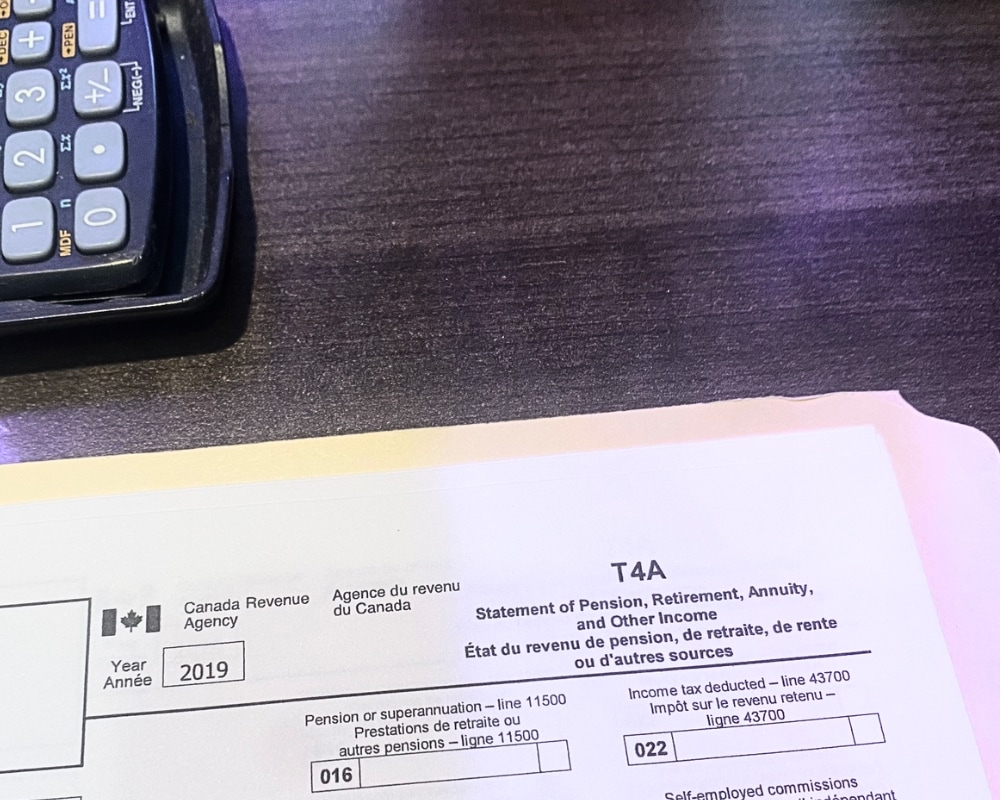
Did you know that if you are both an employee and self-employed, you are allowed to reduce the taxes you owe or already paid from your job from the potential losses you incurred from your net self-employment income from your business? This is a fact that needs to be better known.
So where do we go next?
The next step is to see where and what your situation is. Is your situation simple or complicated? Do you feel confident that you can tackle your self-employment taxes yourself?
To be completely honest, if your situation is simple and you have few expenses for your self-employment business, then there is nothing wrong with attempting to try it yourself.
As stated in our article on Personal Income Taxes Canada, if you feel confident attempting it yourself, use a tax software you feel comfortable with. I recommend UFile as it is user friendly and cost efficient.
As a tax specialist, I use a Professional version of UFile. They do, however, have a starter software that is very user-friendly and quite reasonably priced.
If you are not confident that you can prepare your own tax return or if you have no interest in attempting this yourself, we highly suggest contacting one of our representatives at gauvreauetfamille.ca, who are professional tax preparers for all of Canada.
A final recommendation;
One suggestion that I highly recommend for all clients is to keep everything electronic. There are a few reasons for this including finding records, finding receipts, and not having a ton of paper.
The easiest way to start this is to start right from the start of your business. I suggest buying a scanner that allows you to not just scan documents, but also receipts.
Next is what to do with those electronic copies. I highly suggest keeping your records on an encrypted thumb drive like a Sandisk Cruzer Glide or the Sandisk Extreme portable SSD for your home copies.
As a secondary backup I highly suggest using an encrypted cloud server such as Proton Drive, which also allows you to transmit your documents securely.

Having a scanned copy of your receipts makes life so much easier since both governments generally accept digital copies of receipts as proof.
Additionally, most regular receipts are heat printed, so after a while, they tend to go blank. Sometimes even within a few months.
Finding receipts after the fact is so much easier if you properly organize them. I personally use the following format: YYYY-MM-DD Name of business type.
With this, if you log each receipt on a spreadsheet or numbers form, then cross referencing will make your life so much easier.
If you have general questions pertaining to this or any of our articles, you can reach out to us using our Contact-Us form.
If you have specific questions, we suggest you reach out to one of our representatives at gauvreauetfamille.ca who may be able to answer your questions.